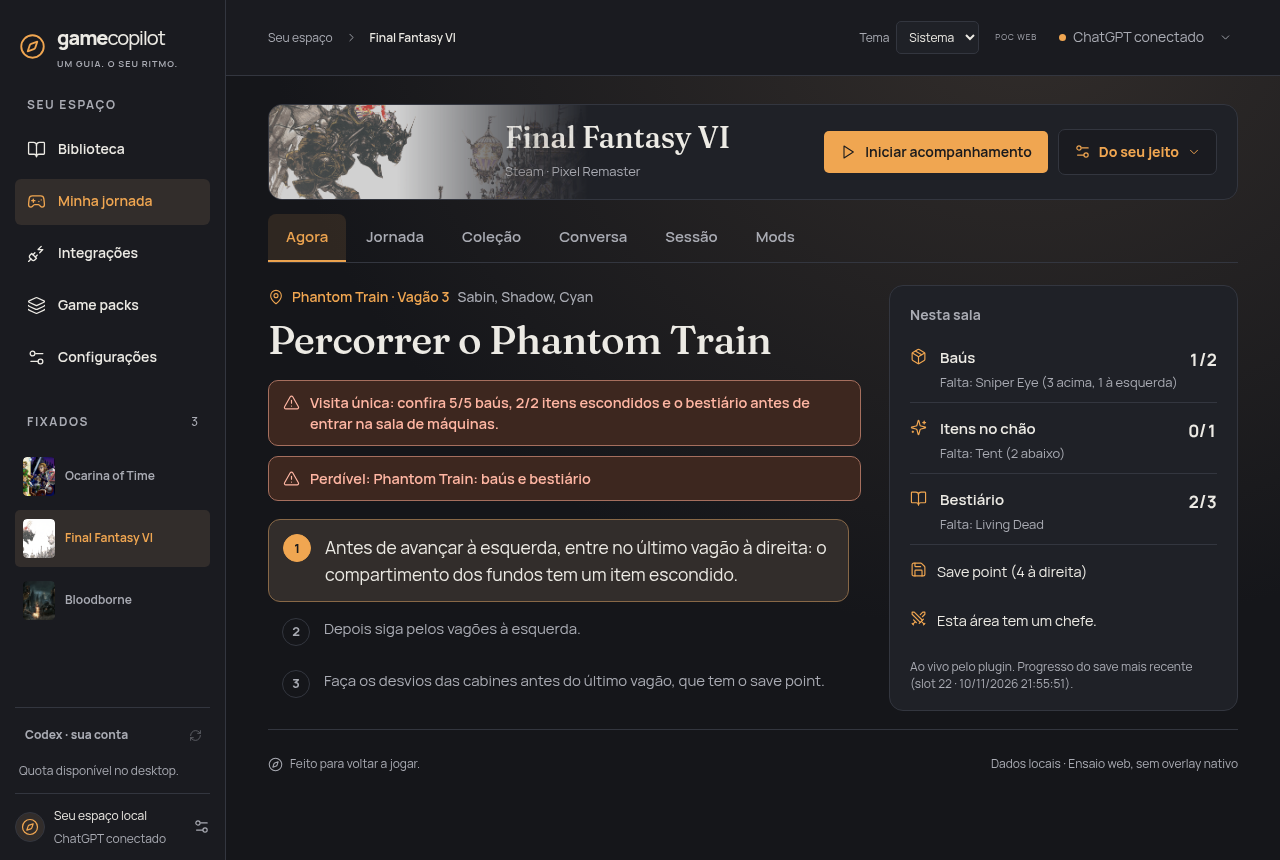

A guide in a browser tab does not know where you are. You stop the game, search, scroll past spoilers and find out too late that you missed a one-time item. The companion has to know your actual position in the game and tell you only what matters right now, without you asking.
A Rust core reads the newest save, turns it into facts (room, party, chests opened, bestiary) and evaluates the rules in the pack for that game. The app and the overlay only display the resulting state. Saves are never written to, and none of this needs AI. A model can be connected for questions, and it is a separate, explicit choice.
What I chose, and what it cost
A game is a manifest, not code
Objectives per chapter, places, one-time items and the rules that decide whether something was collected or missed all live in one YAML file per game, checked against a schema. I did it this way so other people can add games later without touching the app. The cost: a game whose save format is new still needs a reader written in Rust.
The save file is the source of truth, not the screen
Reading the save is exact and costs nothing while you play. The cost: the state is only as fresh as the last save.
AI is optional and never switches provider on its own
Notes, route and live tracking work with no model connected. When a provider is connected, the key stays in the system vault and there is no silent fallback to another paid provider.